The Quiet History of the Personal Appointment Book
The personal appointment book put plans and private intentions on dated pages. Learn how its format shaped daily attention—and how to read old entries cautiously.
The personal appointment book gave its owner one place to check a date before accepting another commitment. Its history is difficult to reduce to a single invention: people used diaries and memorandum books for plans before printed pages offered a repeatable appointment format.
How did appointment books differ from diaries?
A diary often records what happened; an appointment book reserves space for what is expected to happen. The distinction is not absolute. A dated page can hold a plan in the morning and a note about the day after it has passed.
Before standardized printed layouts, personal records took varied forms. Diaries, account books, and memorandum books could collect names, expenses, reminders, and reflections in the same volume. Their arrangement depended on the keeper, so two books with similar contents might be organized quite differently.
Printed appointment books offered a ready-made structure: dates, ruled spaces, and sometimes calendars or memorandum pages. That description identifies a format, not a precise point of origin. Without a particular surviving edition or reliable publication record, it would be misleading to assign the form a single inventor or definitive starting year.
What did portability change?
A book carried in a pocket or small bag could be checked away from a desk, while arranging a visit or running an errand. That made it easier to consult the record before making a new promise instead of relying entirely on memory.
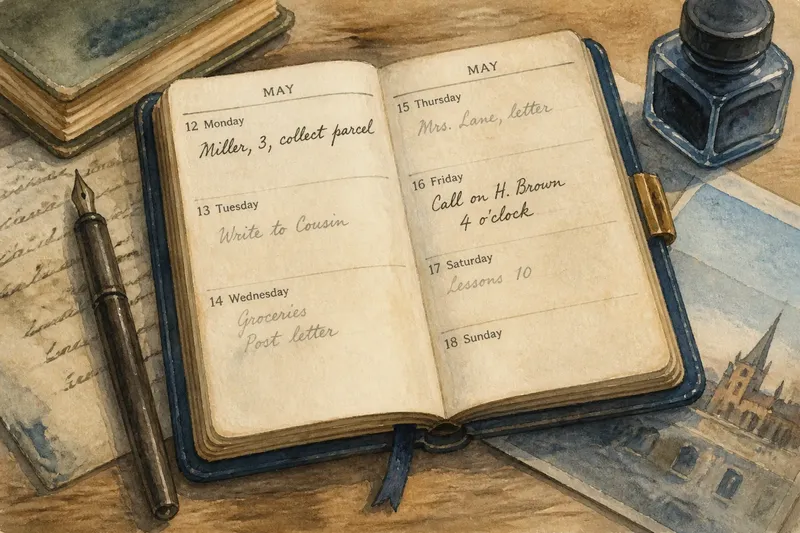
Compact pages also encouraged short entries. A name, place, time, or reminder might fit where a longer account would not. The result could be useful to the owner and obscure to someone who lacked the context. A note such as “Mrs. Lane, letter” might identify a task, but not explain its urgency or the relationship behind it.
Imagine a fictional shopkeeper who writes “Miller, 3, collect parcel” beside a later note to write to a cousin. The first entry records a timed arrangement; the second is an intention without a meeting time. If a delivery changes the afternoon, the owner can see both obligations together and decide which to move. The example shows what a dated page makes visible, not how every historical owner used one.
Which commitments could share a page?
An appointment book could hold business calls, lessons, travel arrangements, social visits, household duties, and reminders that were not appointments. Settling an account or finishing a letter has no meeting time, but it still competes for attention on a dated page.
This mixture brought external demands into contact with private intentions. The entries might receive different amounts of space or carry different consequences, but sharing a page made them easier to compare. The book did not decide which mattered more; its owner did.
A short run of entries can suggest recurring visits or duties, but it does not explain how the owner felt about them. The book is evidence of what was recorded, not a transparent account of the person’s inner life.
How did printed layouts frame time?
A page divided by date invites its user to treat time as a series of places for commitments. Blank space may look available, while a crowded page may seem settled before the day begins. Those are possibilities encouraged by the layout, not evidence that every owner followed it closely.
Printers could repeat a standard arrangement and distinguish formats with features such as calendars, address pages, or ruled notes. A buyer then used the available structure, adapted it, or left parts untouched. The printed page supplied an arrangement; it did not dictate a routine.
An unused space has several possible explanations. The owner may have had no plan, kept another record, forgotten to write, or used the book selectively. It is safer to treat the blank as an absence of an entry than as proof of leisure.
How should readers interpret an old appointment book?
For historians and family researchers, a surviving book may preserve names, places, and patterns not recorded elsewhere. Repeated entries can point to recurring contact, while a change in handwriting may prompt questions about later additions. Neither clue explains itself; surrounding records and the book’s condition matter.
Use this short reading checklist to separate observation from interpretation:
- Check the cover, title page, and any printed date; if they identify an edition or period, record that evidence, and if they do not, avoid assigning a precise date from format alone.
- Check whether an entry is in ink, pencil, or a different hand; if the difference is clear, note it as a possible later addition, and if it is uncertain, describe the mark without attributing it to a person.
- Check whether names or tasks recur on dated pages; if they do, describe the pattern as repeated entries, and if they do not, do not infer a continuing relationship.
- Check nearby entries and related documents for context; if they support an interpretation, state the connection cautiously, and if they do not, leave the entry unresolved.
- Check for personal names, addresses, or sensitive household details before sharing a transcription; if they could expose living people or private information, limit access, and if they pose no such concern, still share only what is relevant.
- Check whether a page is truly blank or has faint writing, erasures, or marks; if there is visible evidence, describe it, and if there is none, say only that no entry is visible.
For example, imagine a fictional family researcher finds “Miller, 3, parcel” in a pocket book beside a penciled appointment on the same date. The researcher checks the printed calendar, notes that the parcel entry is in ink and the appointment in pencil, then compares nearby pages for recurring names. No related letter or account appears, so the sound result is limited: the book records two entries, perhaps made at different times; it does not establish who Miller was or whether the parcel was collected. That is less dramatic than a solved mystery, but more useful than an invented certainty.
What do readers ask about personal appointment books?
When did pocket appointment books become common?
There was no single moment when one format displaced all others. Portable diaries and memorandum books existed in varied forms, and printed appointment books developed alongside changing practices of record keeping.
How is an appointment book different from a diary?
An appointment book emphasizes dated plans and reminders, while a diary often records events or reflections. Many owners combined both uses, so a cover title does not settle how the pages functioned.
Were appointment books only for work?
No. A page could contain professional engagements, social visits, household duties, errands, and private intentions. The mix depended on the owner and the book’s layout.
Does a blank page mean the owner had free time?
Not by itself. The owner may have had leisure, used another record, forgotten to write, or consulted the book only occasionally; nearby entries may offer context without proving which explanation is right.
Why does the personal appointment book still matter?
The personal appointment book put duties and intentions on the same dated pages without making them equivalent. That small arrangement made competing claims on a person’s attention easier to see, even when the day offered no neat way to honor them all.
When reading one, start with what the page actually records, then separate that observation from any explanation. The personal appointment book can reveal a pattern of attention, but the gaps deserve the same caution as the entries.