A Gentle End-of-Week Reset for the Desk
An end-of-week desk reset turns a crowded work surface into a clear closing ritual, with a small cue that helps you leave work behind for now.

An end-of-week desk reset should help you leave work, not give Friday afternoon another assignment. Clear the space you use, mark what still has your attention, and put one small signal in place for when you return. The result is not a perfect desk; it is a boundary between working and being done for now.
What should the reset help you leave behind?
Begin by noticing what is keeping you mentally at work. It may be a marked-up page, a half-finished sketch, a stack of forms, or simply the feeling that something will be forgotten. Choose the smallest action that addresses that particular source of friction.
Try this compact sequence:
- Look at the main work surface. If unrelated objects are crowding it, move them to their usual homes; if they belong to someone else or a shared project, put them in the agreed shared location instead.
- Check loose paper. If a page is finished and has no further use, recycle or file it; if it needs a decision or action, place it in the established active-work spot rather than making a new pile.
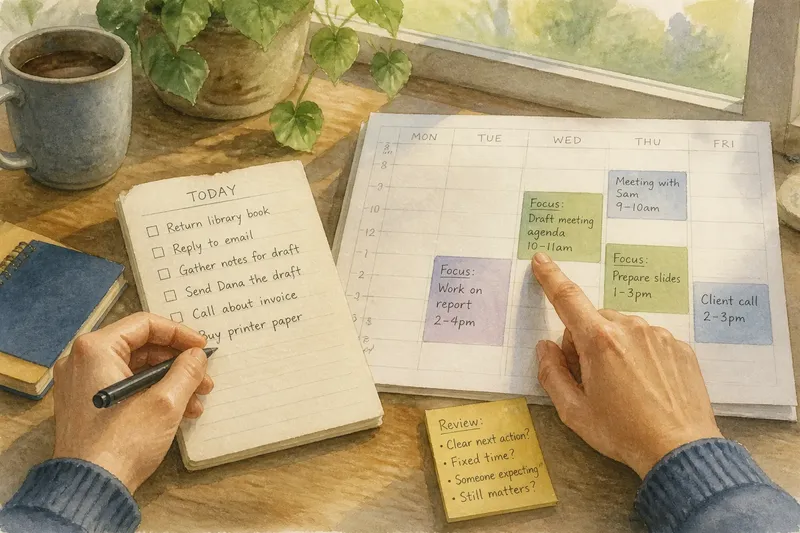
- Notice unfinished work that is nagging at you. If one item is likely to occupy your evening, write a short note about what remains; if nothing specific is troubling you, do not manufacture a task list for the sake of the ritual.
- Check whether the desk is shared. If your materials can be moved without affecting another person, place them in your own folder or container; if moving them could interrupt shared work, leave them and make the boundary clear in another way, such as closing your notebook.
- Check your energy and departure time. If you have a little room, put away the obvious clutter; if you need to leave now, capture one important thought and stop.
- Look at the space you will return to. If a single object or note can mark a useful pause point, leave it visible; if the cue would add clutter or pressure, leave the surface plain.
Each decision should reduce a specific source of friction. A full drawer reorganization is not a desk reset; it is a separate project wearing a convenient hat.
How can the desk mark a real stopping point?
Physical actions can make the end of work easier to recognize. Close the notebook, cap the pen, return the mug to the kitchen, or switch off the desk lamp. These are ordinary actions, which is their advantage: they do not require a new system or an especially persuasive mood.
Choose a closing action that fits your workspace. If you work at a shared table, clearing your materials may matter more than arranging them. If you work in a studio, covering an in-progress piece may protect it while signaling that you are finished for now. The aim is to leave the work in a state you can willingly encounter again, not to erase evidence that it exists.
Say you are leaving a shared kitchen table with a notebook, a laptop, and a draft that needs another pass. You close the laptop, put the notebook and draft in your own folder, and wipe away a few crumbs. The visible result is a table another person can use, while the folder keeps your work together without demanding more attention tonight.
What should you do with unfinished work?
Capture only the part that needs to stay in mind. A short phrase can preserve a useful pause point: “outline has three sections; next, revise the opening.” If the work is waiting on another person, name that dependency plainly, such as “waiting for Jordan’s comments.” This is not a second task system. It is a note that lets you put the work down without pretending it has vanished.
Put the note where you are likely to see it when you return, such as inside the notebook or in the folder holding the work. Avoid leaving it amid unrelated papers: a cue buried in clutter is less a cue than a small archaeological challenge. If you do not need a note to remember where you stopped, leave one out.
Keep the distinction between remembering and planning. A desk reset can preserve context, but it does not need to settle next week’s priorities, solve a difficult decision, or create a timetable. Those can wait for the setting in which you normally make them.
How much tidying is enough?
Enough means the surface is ready for its next ordinary use and anything you need to retain is not at risk of being lost. It does not mean every drawer is sorted, every file is renamed, or every visible object has been judged worthy of life.
If an item has no obvious home, do not invent a filing system while tired. Put it in a clearly designated temporary place only if you already have one, or leave it undisturbed if moving it could cause a problem. A modest reset should remove friction, not create a new category of things to manage.
Which desk reset questions come up most often?
What if I share my workspace?
Move only your own materials, and use an agreed tray, folder, or portable container where possible. If an item belongs to shared work, leave it in the shared location and avoid rearranging another person’s materials.
What if my work is mostly digital?
Use one physical closing action, such as shutting the laptop or closing a notebook, and save any essential stopping point in the place you already keep project notes. There is no need to add a new app or duplicate every open item.
What if I am too tired to tidy?
Put away one obvious item or write down one thought you do not want to carry into the evening, then leave. If even that would keep you working longer than you can manage, stopping is the more useful choice.
What if I cannot tell whether a paper matters?
Leave it in a safe, familiar place rather than guessing while rushed. If it is part of shared or sensitive work, follow your workplace’s usual handling practices or ask the responsible person before moving or discarding it.
When should you stop the reset?
Stop when the surface is usable, important work is safe, and you have made any small closing gesture that helps you leave. The end-of-week desk reset works when it makes departure easier, not when it stretches the workday until the desk meets an imaginary standard.
Keep the final cue modest: a closed notebook, an empty spot for your coffee, or a folder holding the page where you stopped. A good end-of-week desk reset lets you recognize that the work remains, while giving you permission not to attend to it right now.